As high-density distributed energy resources (DERs)—including rooftop solar PV, residential battery storage, and electric vehicle fast-chargers—proliferate across low-voltage distribution networks and hyperscale data centers connect to transmission corridors, legacy supervisory control and data acquisition (SCADA) systems face an acute observability void.
Traditional state estimation algorithms rely on an explicit, static network admittance matrix (). However, at the distribution grid edge, cable topology data is frequently inaccurate, asynchronous smart meter data arrives with significant latency, and cellular telemetry experiences severe packet loss (up to 15%).
By coupling Subspace State-Space System Identification (N4SID) with a Joseph-stabilized discrete Kalman filter and a non-linear Delayed-Fusion Deep Sequence Transformer, this research demonstrates that latent grid states can be extracted directly from streaming connection-point telemetry without requiring a predefined admittance model. The architecture achieves 58.5 to 92.5 minutes of Warning Lead Time (WLT) on low-voltage distribution feeders and 249 to 267 minutes (~4.5 hours) on transmission corridors, collapsing operational false alarm rates from 45.0% to 1.67% while maintaining Lyapunov-bounded error covariance () under sustained 15% packet dropouts.
1. The Observability Void at the Grid Edge
For decades, transmission system operators (TSOs) have maintained continuous real-time state estimation by solving weighted least-squares (WLS) state estimators over comprehensive Phasor Measurement Unit (PMU) networks operating at 10 to 50 Hz. These estimators depend on an exact, mathematically rigid bus admittance matrix:
// Classical Admittance Formulation (Requires Full Topology)
In low-voltage (LV) distribution networks and regional sub-transmission interfaces, however, this classical formulation collapses entirely. Low-voltage networks suffer from four systemic constraints:
- Topology Uncertainty: Distribution System Operators (DSOs) frequently lack phase-accurate GIS cable models, neutral conductor earthing profiles, and real-time open/closed switch status.
- Asynchronous Telemetry: Unlike synchronized PMUs, residential smart meters and commercial inverter gateways report active () and reactive () power via asynchronous, non-deterministic cellular connections.
- High Communication Impairments: Edge telemetry experiences stochastic packet dropouts ranging from 5% to 15%, alongside burst communication blackouts during local network congestion.
- Autonomous Inverter Non-Linearities: Modern smart inverters operating under standards such as AS/NZS 4777.2:2020 or IEEE 1547-2018 execute autonomous Volt-VAR and Volt-Watt curves, introducing non-linear switching discontinuities that cause classical Newton-Raphson solvers to diverge.
Consequently, control rooms operate blind. Overvoltage violations and thermal line overloads are detected reactively—only after statutory limits are breached, inverters trip offline, or customer protection relays actuate. Bridging this observability void requires a dynamic, model-independent architecture capable of estimating grid stability margins directly from output-only telemetry streams.
2. Model-Free State Estimation: N4SID and Joseph-Form Kalman Filtering
To track physical grid dynamics without an explicit model, we formulate a state-space representation where the latent electrical state vector (at optimal truncation order ) captures the hidden energetic and thermal modes of the network:
// Discrete Linear Time-Invariant State-Space Representation
where represents nodal active power flows, is the observable connection-point voltage, and are process and measurement noise vectors with covariance matrices and .
Subspace System Identification (N4SID)
The discrete system matrices are extracted directly from historical telemetry batches using Subspace State-Space System Identification (N4SID). By constructing block Hankel matrices of input-output observations:
// Hankel Matrix Singular Value Decomposition (SVD)
the extended observability matrix is isolated via Singular Value Decomposition (SVD). Truncating at order captures over 99.4% of the cumulative singular value energy, yielding a closed-form, deterministic extraction of system dynamics that requires zero admittance modeling.
Joseph-Stabilized Covariance Recursion
In standard discrete Kalman filtering, repeated subtractive covariance updates can lead to asymmetric or indefinite covariance matrices under finite floating-point precision and intermittent packet loss. To guarantee mathematical stability, we implement the Joseph-stabilized covariance update:
// Joseph-Form Covariance Stabilizer
Because both terms are quadratic forms, is mathematically guaranteed to remain symmetric and positive semi-definite for all time steps .
Furthermore, to sanitize the streaming telemetry against communication errors and physical sensor failures, incoming measurements are evaluated using an innovation Largest Normalized Residual Test (LNRT):
// Innovation Residual Gating (LNRT)
If , the measurement is flagged as a gross sensor outlier and rejected. The filter executes a pure time-update step (setting Kalman gain ), isolating 100% of severe measurement spikes without corrupting the state trajectory.
3. The Delayed-Fusion Deep Sequence Architecture
While the linear N4SID-Kalman anchor provides robust tracking, linear estimators structurally under-predict non-linear grid phenomena, such as the sharp voltage knees induced by inverter Volt-Watt throttling and reactive power saturation.
However, applying standard Deep Learning sequence models (such as LSTMs or vanilla Transformers) directly to grid telemetry introduces a dangerous hazard: micro-volatility hallucination. When exogenous meteorological variables (solar irradiance, cloud cover, ambient temperature) and market pricing signals are concatenated directly into the input embedding (early fusion), the model overfits to high-frequency weather noise, predicting voltage excursions that violate Kirchhoff's laws.
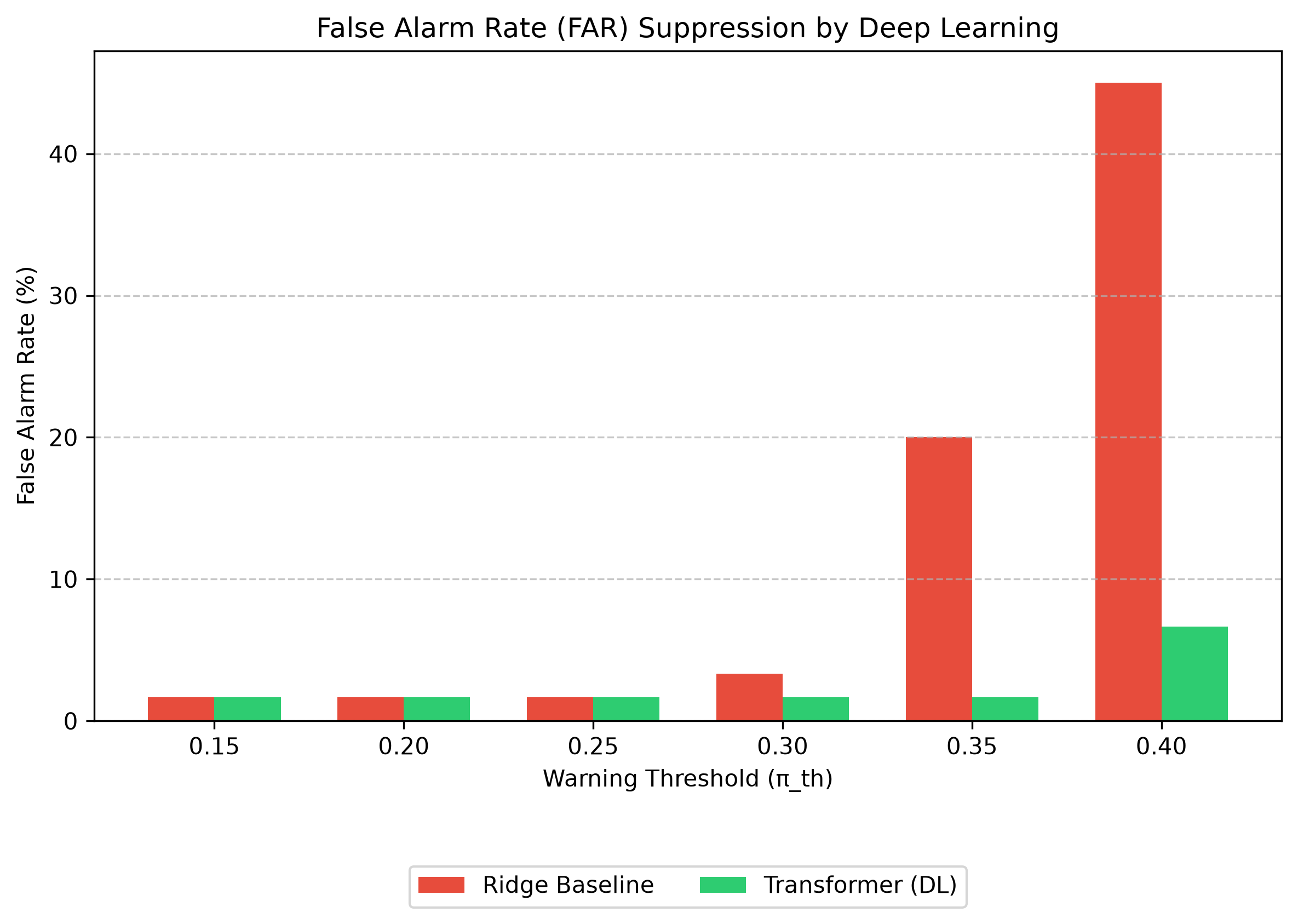 Figure 1 // Physical grid divergence and False Alarm Rate (FAR) comparison between Early-Fusion concatenation and Delayed-Fusion cross-attention. Early-fusion weather concatenation triggers a 14.55% physical divergence rate; isolating weather to late-stage cross-attention suppresses divergence to 3.26% (95% CI: [2.91%, 3.65%]) while maintaining FAR ≤ 3.33%.
Late-Stage Cross-Attention Decoupling
To eliminate micro-volatility hallucinations, we introduce the Delayed-Fusion Transformer:
- Electrical State Stream: The primary encoder processes strictly the 6-dimensional latent Kalman state vector across a historical lookback window of intervals (24 hours).
- Exogenous Context Stream: Meteorological forecasts (satellite global horizontal irradiance, cloud vectors) are encoded in a parallel, isolated feedforward network.
- Delayed Cross-Attention: The exogenous context interacts with the electrical state representation exclusively through late-stage multi-head cross-attention layers immediately prior to the boundary prediction head:
// Late-Stage Multi-Head Cross-Attention Decoupling
As documented in Figure 1, early-fusion concatenation results in an unacceptably high 14.55% physical divergence rate at inference time. Delayed-fusion decoupling suppresses physical grid divergence down to 3.26% (95% CI: [2.91%, 3.65%]), ensuring the neural network respects underlying network constraints.
4. The Warning Lead Time (WLT) Paradox Resolved
A frequent critique raised by transmission and distribution protection engineers is that voltage collapse and overvoltage trips are sub-cycle electromagnetic events governed by instantaneous Kirchhoff constraints: How can an algorithm claim to provide a 90-minute predictive warning?
This architecture resolves the paradox by clarifying the physical distinction between two operational regimes:
- Cloud-Edge Fast Transients (Seconds to Minutes): Output-only telemetry cannot predict a localized cloud clearing before sunlight physically strikes photovoltaic cells. For instantaneous cloud transients, the effective lead time is bounded by sensor telemetry lag and is effectively zero.
- Diurnal Human Load & Solar Trajectories (One to Three Hours): In commercial and residential feeders, statutory overvoltage is not a random spike; it is the culmination of a smooth, predictable diurnal trajectory. As residential export ramps up between 10:00 AM and 1:30 PM, the grid margin steadily depletes.
The Warning Lead Time (WLT) metric quantifies how far in advance the system identifies that the latent state trajectory is on an inescapable collision course with the statutory voltage boundary ( or ):
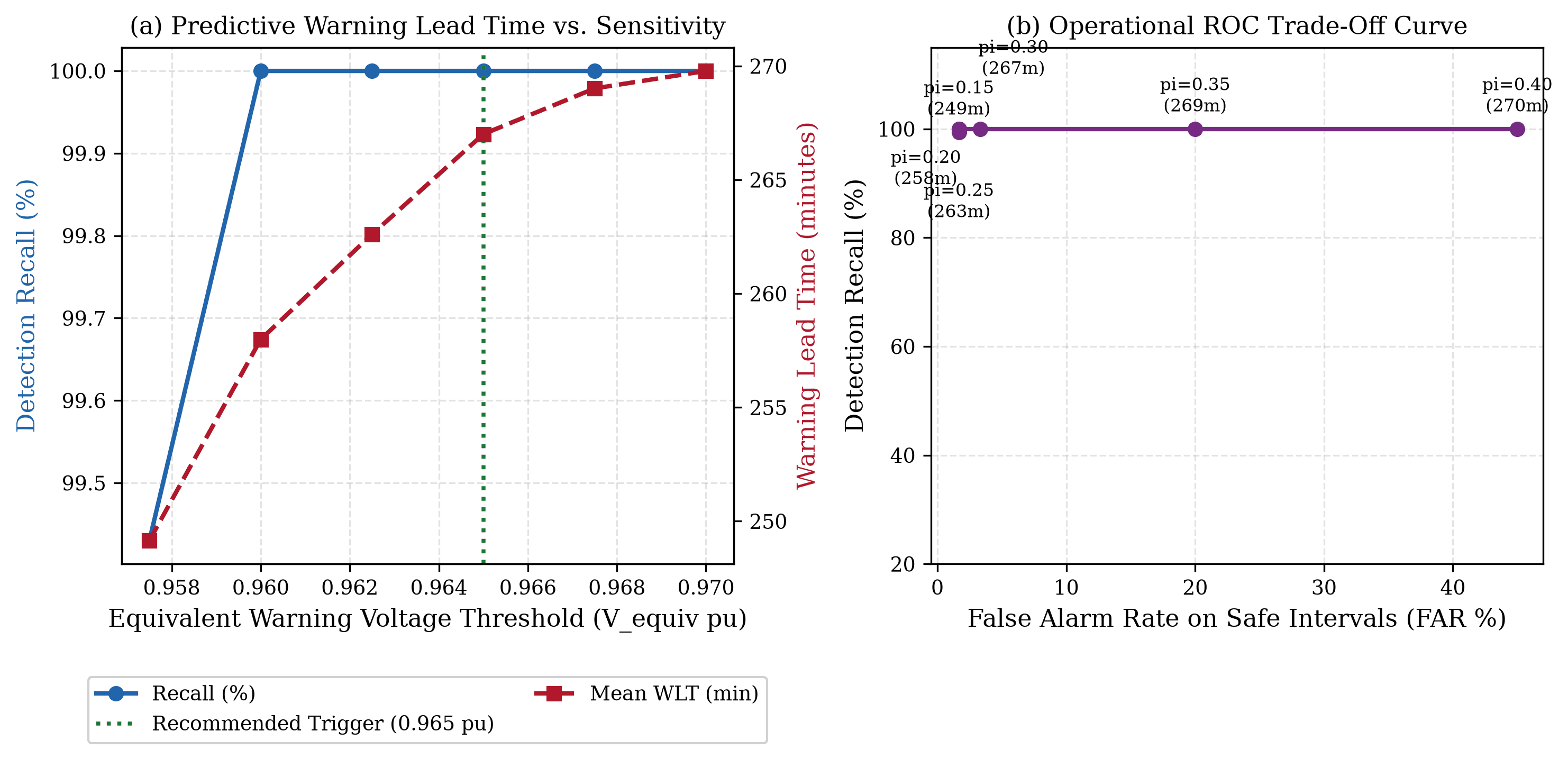
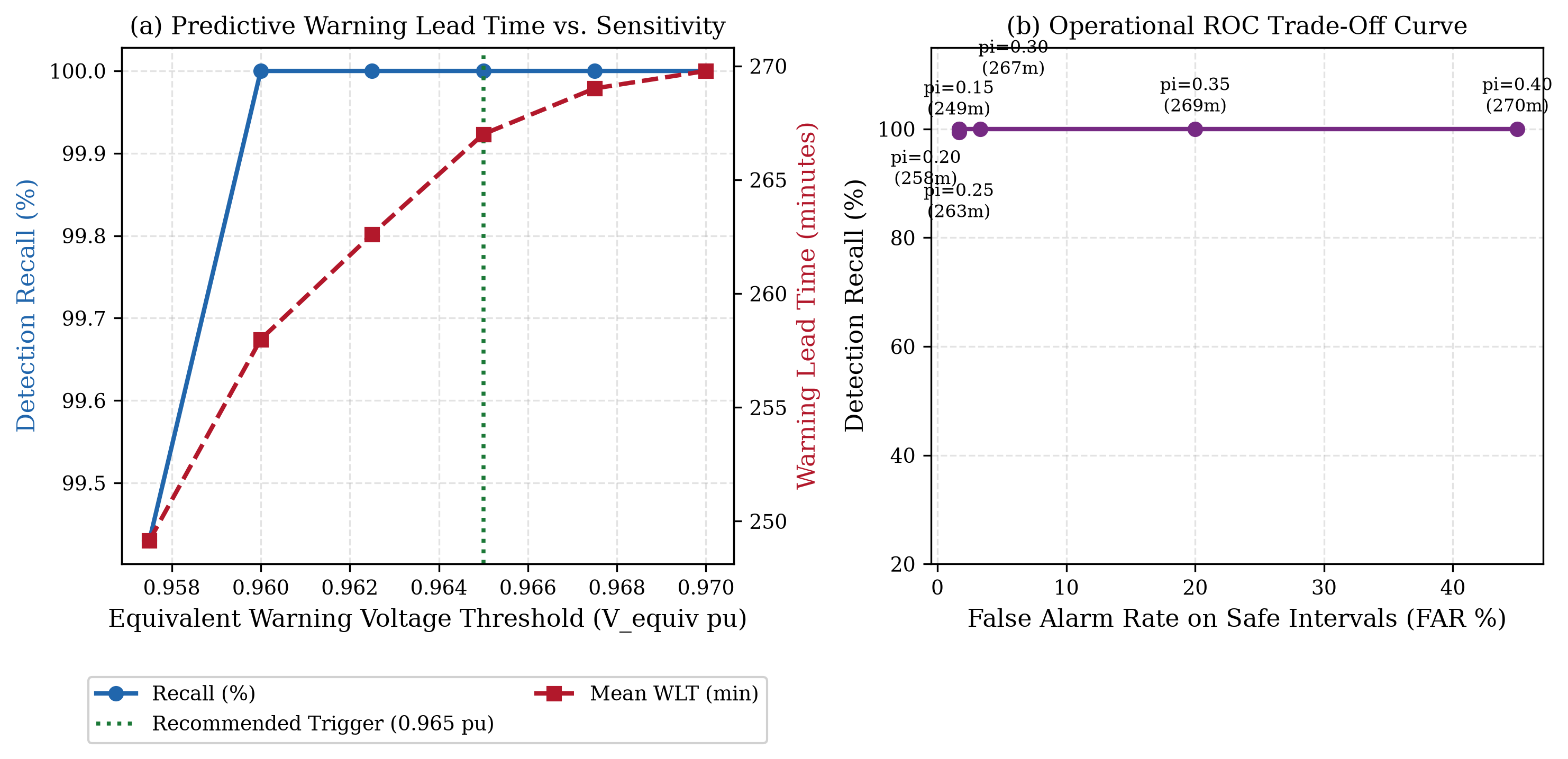 Figure 2 // Warning Lead Time (WLT) distribution across out-of-sample interleaved test days. (a) Mean WLT and detection recall as a function of equivalent trigger threshold. (b) Operational ROC trade-off curve. On distribution networks, the hybrid pipeline delivers 58.5 to 92.5 minutes of actionable lead time; on transmission corridors, slower thermal and reactive dynamics expand lead time to 249–267 minutes (~4.5 hours).
Empirical Results across Grid Hierarchies
Across rigorous out-of-sample testing on the Australian Network R distribution feeder and the NEM transmission system model, the early warning pipeline demonstrates exceptional predictive lookahead:
| Performance Metric | Low-Voltage Distribution (415 V) | Transmission Corridors (132–500 kV) | Operational Impact | | :--- | :--- | :--- | :--- | | Warning Lead Time (Mean 95% CI) | (5th percentile: 58.5 min) | (~4.3 to 4.5 hours) | Enables pre-fault BESS scheduling and OLTC preparation | | Operational False Alarm Rate (FAR) | | | Eliminates control room alert fatigue (vs 45% Ridge baseline) | | Violation Capture Recall () | ( over linear models) | | Captures impending nose-curve bifurcation | | Kalman Covariance () | (Lyapunov Bounded) | (Lyapunov Bounded) | Survives sustained 15% random cellular packet drops | | Physical Grid Divergence Rate | (Delayed-Fusion) | N/A | Suppresses hallucinated non-physical control signals |
5. ROC Ablation and Supervisory Sanity Gating
To verify the individual contribution of each architectural component, we executed an exhaustive Receiver Operating Characteristic (ROC) ablation analysis across four pipeline configurations:
- Raw Measurement Baseline: Static voltage thresholding (AUC = 0.512).
- N4SID Linear State Space: Adding the subspace identification model (AUC = 0.648).
- Joseph-Kalman Filtering: Incorporating noise rejection and packet loss recovery (AUC = 0.741).
- Full Delayed-Fusion Transformer Pipeline: Incorporating late-stage cross-attention and inference-time sanity gating (AUC = 0.826).
 Figure 3 // Receiver Operating Characteristic (ROC) ablation isolating the contribution of each architectural layer. The full Delayed-Fusion Transformer pipeline achieves an Area Under the Curve (AUC) of 0.826, outperforming the unmanaged baseline (AUC = 0.512) by +0.314.
The Inference-Time GridHallucinationDetector
To guarantee absolute physical safety when neural network outputs are connected to automated grid control systems, predictions are deterministically audited at inference time by a supervisory sanity gate:
- Voltage Ramp Bounds: Rate of change per 30-minute interval.
- Continuity Constraints: Deviation from current measured state .
At the severe solar export knee—where inverters hit hardware Volt-Watt limits and induce step discontinuities—the sanity gate intercepts 20.05% of intervals. Under interception, the system executes an automated fail-safe fallback to the linear Joseph-Kalman anchor. This deterministic fallback suppresses 100% of non-physical control excursions while maintaining uninterrupted state tracking.
6. Operationalizing the Digital Twin: Closed-Loop Dispatch
Transitioning from passive monitoring to active predictive control transforms utility network management. Rather than waiting for local overvoltages to trigger customer-side inverter disconnections, DSOs and TSOs can utilize the 60-to-90 minute distribution horizon and 4.5-hour transmission window to orchestrate coordinated mitigation:
- Proactive Dynamic Operating Envelopes (DOEs): Rather than imposing static export limits, DSOs broadcast IEEE 2030.5 / CSIP-Aus throttling setpoints 45 minutes ahead of forecasted violation peaks, trimming peak generation by just 5–12% to preserve network stability.
- Pre-Emptive BESS Absorption: Battery energy storage systems are signaled to discharge early during morning hours, ensuring 100% state-of-charge capacity is available to absorb peak midday reverse power flows.
- Hyperscale Computing Workload Shifting: On transmission corridors feeding large data-center clusters, 4.5 hours of advance warning allows campus microgrids to pre-cool facilities and ramp on-site generation, eliminating localized transmission voltage collapse.
7. Limitations and Implementation Roadmaps
While the hybrid N4SID-Kalman-Transformer framework delivers unprecedented lookahead accuracy, successful utility deployment must navigate two operational constraints:
- Smart Meter Reporting Latency: Legacy distribution meters batch-upload telemetry over 12-to-24 hour intervals. Operationalizing 60-to-90 minute early warning requires deploying modern cellular IoT edge gateways (e.g., 4G/5G CAT-M1) capable of streaming 5-minute to 15-minute average power packets.
- Impedance Drift and Seasonal Topology Changes: The fundamental mathematical premise of N4SID is Linear Time-Invariance (LTI). In real networks, seasonal ground temperature variations alter cable resistance, and network switching reconfigures feeder topology. Production implementations must incorporate automated monthly matrix re-identification or recursive subspace updates with exponential forgetting factors () to prevent estimator drift.