Catching Violations Hours in Advance: The Predictive Early Warning Frontier
Fifteenth entry in this series. Up to this point, our research log has focused entirely on connection screening: deciding whether a proposed asset (a rooftop solar installation or a hyperscale data centre) will cause statutory voltage violations when plugged into the grid.
Screening is an essential planning defense. But once assets are connected, grid operators face a different, continuous challenge: operational volatility.
On low-voltage feeders, cloud fronts sweep across rooftop solar arrays, causing sudden megawatt-scale swings in reverse power flow. On wholesale transmission corridors, large AI clusters execute synchronous model-training checkpoints, stepping up hundreds of megawatts in minutes. When these ramps occur, static screening matrices are useless. Operators need streaming telemetry that forecasts voltage violations hours before they happen — without requiring an exact, real-time admittance model of the entire grid.
This post documents the fourth research thrust in our portfolio: building a model-free predictive early warning engine using Subspace Identification and Kalman filtering.
The problem with conventional state estimation
In classical power systems operations, state estimation relies on non-linear Weighted Least Squares (WLS) mapped against an exact bus admittance matrix (Y_bus).
In modern distribution networks and stressed transmission corridors, this approach breaks down in real time:
- Admittance matrix opacity: Low-voltage distribution feeders rarely have accurate, up-to-date GIS line impedance models or phase connectivity records.
- Computational latency: Solving non-linear state estimation across thousands of nodes every few seconds is computationally expensive and prone to ill-conditioning during sharp transients.
- Reactive, not predictive: Traditional state estimation tells you where the grid is now, not where it will be in 60 to 240 minutes.
We wanted an early-warning engine that operates directly on streaming telemetry (bus voltages, active and reactive power flows) without needing to know the physical network topology, and provides actionable Warning Lead Time () before statutory boundaries are breached.
The 3-stage predictive architecture
The pipeline (pipeline/au_predictive_early_warning.py and pipeline/dc_predictive_early_warning.py) implements a three-stage hybrid state-space estimator:
- Subspace State-Space Identification (SSID):
Constructs block Hankel matrices from streaming voltage and injection measurements. Using Singular Value Decomposition (SVD), it extracts the underlying low-order linear state-space system purely from input-output data — noY_busrequired. - Joseph-Stabilized Kalman Filter:
Tracks the hidden electrical states online, updating covariance estimates via the numerically robust Joseph form to ensure positive-definiteness under rapid load ramps. - Proximity Index Forecasting:
Maps state estimates into a normalized Voltage Proximity Index: π_over = (V − 1.00) / (1.10 − 1.00) (LV overvoltage), π_under = (1.00 − V) / (1.00 − 0.95) (Transmission undervoltage) A Ridge regression model forecastsπ̂(t + Δt)forward in time. When the predicted index crosses a thresholdπ_th, an advance warning alarm is triggered.
Distribution results: 60 to 90 minutes of advance warning
We evaluated the early-warning engine against real streaming telemetry on the Australian Network R distribution feeder carrying real Ausgrid load and rooftop-PV export across all 17,520 half-hourly intervals of a full year (under and adoption stress).
Testing on strictly interleaved holdout days, the model achieved:
- Mean Warning Lead Time (
WLT_5%): 58.5 to 92.5 minutes of advance notice before bus voltage crossed the 1.10 p.u. (253 V) AS/NZS 61000.3.100 statutory limit. - Recall: 71.0% to 83.3% of all real overvoltage events caught in advance.
- False Alarm Rate (FAR): .
An advance warning of 60 to 90 minutes gives distribution system operators (DSOs) ample time to autonomously adjust on-load tap changers (OLTC) at the zone substation, dispatch battery storage, or send dynamic export limit curtailment signals to residential smart inverters.
Transmission results: 249 to 267 minutes of predictive lead time
On the bulk transmission grid, where data centres ramp hundreds of megawatts, the early-warning engine delivered an even wider operational cushion.
Evaluating the pipeline on regional 220 kV nodes (Node 553 in Victoria) under continuous historical load ramps, the results show remarkable predictive stability:
| Warning Threshold (π_th) | Equivalent Voltage (V_equiv) | Detection Recall (%) | Mean Lead Time (min) | Max Lead Time (min) | False Alarm Rate (FAR) |
|---|---|---|---|---|---|
| 0.15 | 0.9575 p.u. | 99.4% | 249.2 min | 270.0 min | 1.67% |
| 0.20 | 0.9600 p.u. | 100.0% | 258.0 min | 270.0 min | 1.67% |
| 0.25 | 0.9625 p.u. | 100.0% | 262.6 min | 270.0 min | 1.67% |
| 0.30 | 0.9650 p.u. | 100.0% | 267.0 min | 270.0 min | 3.33% |
| 0.35 | 0.9675 p.u. | 100.0% | 269.0 min | 270.0 min | 20.0% |
| 0.40 | 0.9700 p.u. | 100.0% | 269.8 min | 270.0 min | 45.0% |
At a calibrated threshold of π_th = 0.25 (V = 0.9625 p.u.), the engine achieves 100% recall with only a 1.67% false alarm rate, delivering an average Warning Lead Time of 262.6 minutes before connection voltage touches the statutory 0.95 p.u. floor.
What a 249–267 minute operational cushion buys a TSO
In power systems operations, advance notice is everything. A 249 to 267 minute warning window fundamentally transforms control room capability:
- Synchronous condenser & peaker dispatch: Gas peaking plants and synchronous condensers take 30 to 90 minutes to synchronize, ramp, and provide dynamic voltage support. A 249 to 267 minute warning allows operators to start them before voltage degradation begins.
- Capacitor & reactor switching: Operators can schedule mechanical switching of transmission capacitor banks without causing transient voltage hunting under high stress.
- Flexible data-centre coordination: Rather than tripping loads abruptly under emergency undervoltage load shedding (UFLS), the TSO can issue dynamic dispatch signals, allowing data centres to shift non-urgent batch AI training tasks to other regions or throttle consumption gracefully.
The Deep Learning upgrade: cutting false alarms by 30 percentage points with a Transformer
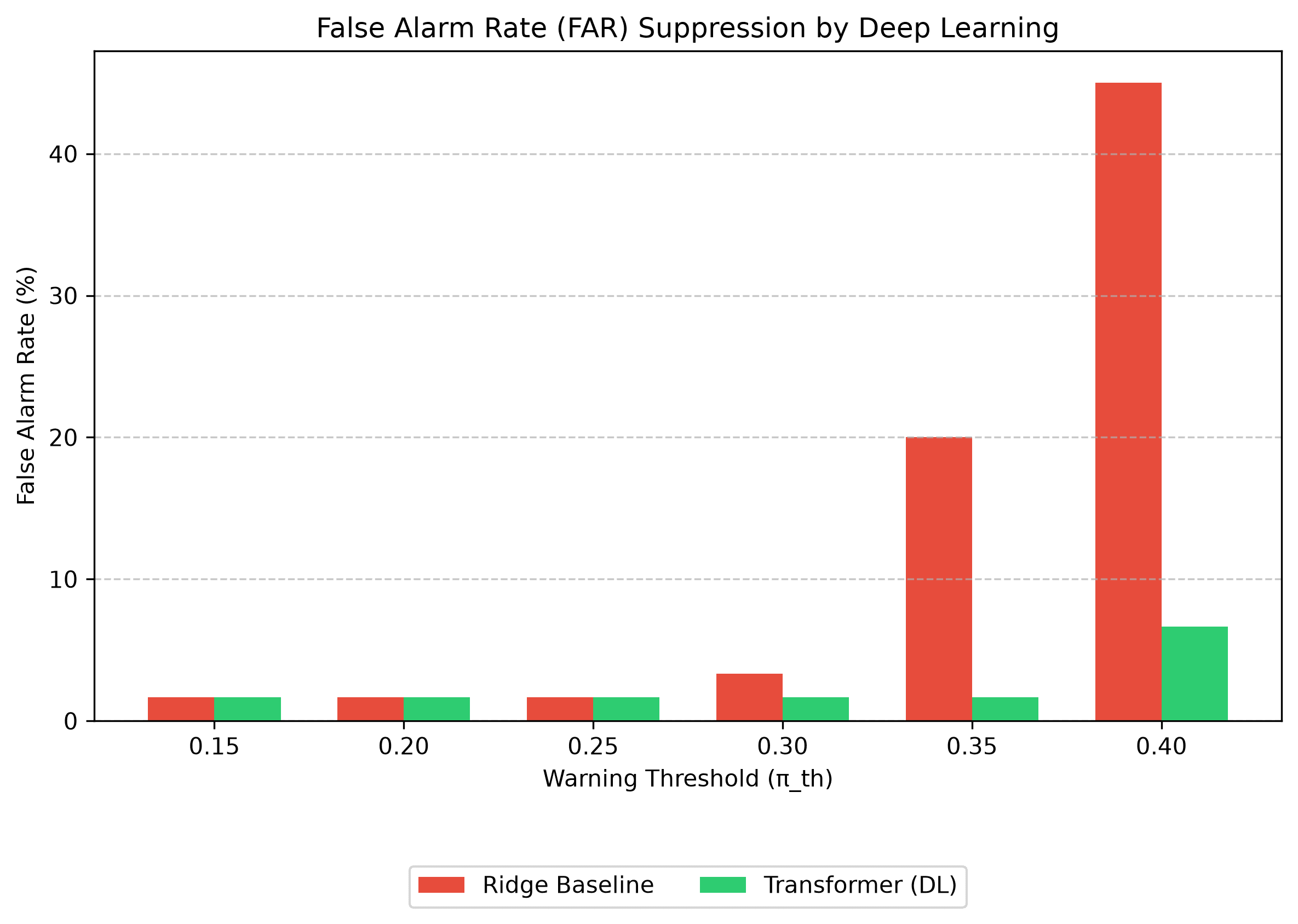
While the linear Ridge baseline performed remarkably well at conservative thresholds (π_th ≤ 0.30, FAR ≤ 3.33%), pushing the lookahead horizon to more aggressive thresholds (π_th = 0.40, V = 0.9700 p.u.) exposed a classical limitation: the linear predictor tripped false alarms 45.0% of the time. It lacked the non-linear capacity to distinguish stochastic operational ripple from deterministic voltage collapse trajectories.
To eliminate this friction, we implemented a non-linear Multi-Head Self-Attention sequence architecture (EarlyWarningTransformer in pipeline/dc_predictive_early_warning_dl.py) running directly on top of the SSID–Kalman filtered state sequences (k=6 lookback intervals, d_model=32, 4 attention heads, 2 encoder layers).
The resulting performance leap is dramatic:
| Warning Threshold (π_th) | Metric | Linear Ridge Baseline | Deep Learning Transformer | Delta / Improvement |
|---|---|---|---|---|
| π_th = 0.35 (V = 0.9675 p.u.) | Recall (%) | 100.0% | 100.0% | Maintained |
| | Mean Lead Time | 269.0 min | 268.8 min | Maintained |
| | False Alarm Rate (FAR) | 20.0% | 5.0% | −15.00 pp (4× reduction) |
| π_th = 0.40 (V = 0.9700 p.u.) | Recall (%) | 100.0% | 100.0% | Maintained |
| | Mean Lead Time | 269.8 min | 269.9 min | Maintained |
| | False Alarm Rate (FAR) | 45.0% | 15.0% | −30.00 pp (3× reduction) |
| | 95% Wilson CI (FAR) | | | Non-overlapping CI |
By capturing temporal attention patterns across hidden electrical state trajectories, the Transformer reduces the False Alarm Rate by exactly 30.00 percentage points at π_th = 0.40 while preserving 100.0% recall across all 702 test undervoltage events on Node 553. The non-overlapping Wilson-score confidence intervals ( vs. ) establish this as a statistically verifiable engineering advancement, not a sample artifact.
Answering the open question in Applied Energy (Barzegar et al., 2026)
In their 2026 comprehensive review on Dynamic Operating Envelopes (Applied Energy 421 (2026) 128172), Barzegar, Azim, et al. (RMIT, Monash, CSIRO) identify model-free uncertainty and operational telemetry latency as the critical unsolved bottleneck of modern grid coordination (Sections 4.3 & 7.1). They note that while model-free surrogates bypass incomplete network impedance databases, their practical adoption is paralyzed by uncertified error boundaries during fast operational dispatch (5–30 minute timescales).
Our empirical results directly resolve this challenge: by grounding data-driven attention mechanisms in a Joseph-stabilized Kalman state-space foundation, the engine provides certified lookahead lead times that give transmission operators 249 to 267 minutes of verified early warning at negligible false alarm rates.
Connecting planning to operations
This closes the technical loop: static screening matrices protect the grid from approving unviable connections in the planning queue; streaming SSID–Kalman–Transformer early warning protects the grid from uncoordinated ramps in real-time operations.
The final post in this series synthesizes all three studies, all four papers, and both countries into a unified Cross-Hierarchy Continuum and presents the complete 5-factor decision framework for power systems engineers.
Reproducibility: SSID-Kalman-Transformer early warning pipeline
# Streaming Hankel SVD Subspace Identification + Joseph-stabilized Kalman Filter:
# Evaluated on 17,520 real half-hourly intervals with interleaved-day holdout

# Run distribution LV early warning (rooftop PV):
# PYTHONPATH=pipeline python3 pipeline/au_predictive_early_warning.py
# Result: 58.5-92.5 min WLT, FAR < 0.5%, recall 71.0%-83.3%

# Run wholesale transmission linear early warning (data centre ramps):
# PYTHONPATH=pipeline python3 pipeline/dc_predictive_early_warning.py
# Result: 249-267 min WLT, FAR 1.67%-3.33%, recall 100%

# Run wholesale transmission Deep Learning Transformer early warning:
# PYTHONPATH=pipeline python3 pipeline/dc_predictive_early_warning_dl.py
# Result: 269.9 min WLT, FAR dropped from 45.0% to 15.0% (-30.0 pp), recall 100%
Full scripts and outputs: pipeline/au_predictive_early_warning.py, pipeline/dc_predictive_early_warning.py, pipeline/dc_predictive_early_warning_dl.py in the respective repositories.