
Bridging the Talent Gap: From Future Engineer to Industry Innovator
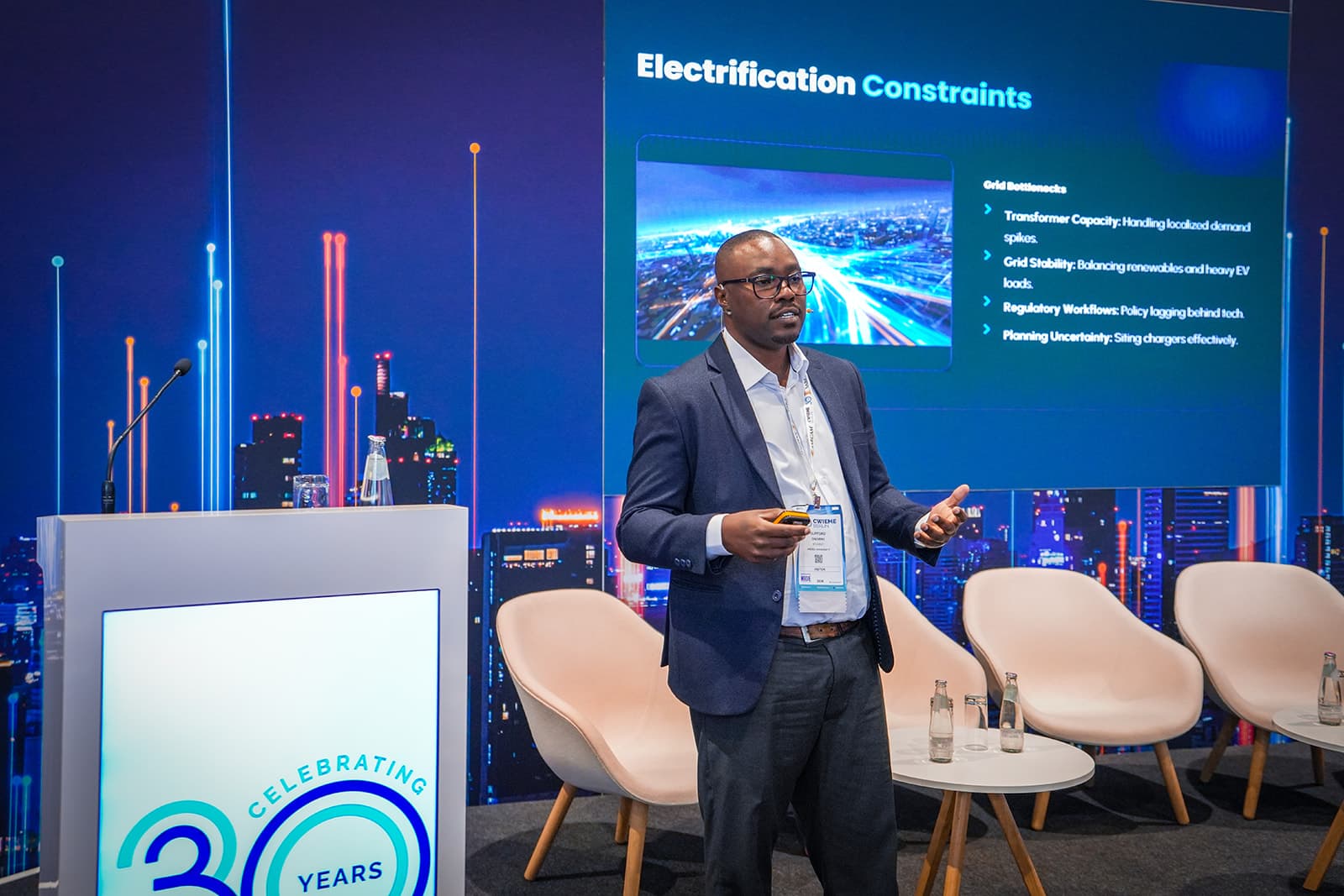
I was invited to speak at CWIEME Berlin 2026's Future Engineers Programme on the Central Grid stage, part of the event's 30th-anniversary Diversity & Inclusion track. The session traced my own path from academic research into industry-ready grid engineering — and made the case for why closing that gap matters more urgently than most of the sector has admitted.
The spark
The talk opened with a line that shaped everything after it: the challenge was never only hardware — it was systems coordination. Grid engineering problems rarely fail because a transformer wasn't rated correctly. They fail because the hardware, the software managing it, and the policy governing it were designed by three teams that never talked to each other.
Grid bottlenecks, made concrete
To ground that claim, I walked through the specific bottlenecks I've run into in EV-integration work:
- Transformer capacity — handling localized demand spikes that legacy sizing never anticipated.
- Grid stability — balancing renewables against heavy, unpredictable EV charging loads.
- Regulatory workflows — policy that lags years behind the technology it's meant to govern.
- Planning uncertainty — siting chargers effectively without real demand data to plan against.
These aren't abstract constraints. They're the day-to-day reality of trying to electrify a city's transport network on top of a grid that was never designed for it.
NSGA-II and geospatial optimization
The technical core of the session was the multi-objective framework I've been developing to evaluate urban charging infrastructure deployment — using an NSGA-II genetic algorithm to optimize charger siting across competing constraints (grid capacity, equity of access, land use) simultaneously, rather than solving for one variable and hoping the rest hold up. It's the same research direction that earned an IEEE Best Paper Award in 2025, recognizing the underlying systems-modeling and grid-integration work.
The full value chain
Success in this space requires aligning three layers that too rarely get designed together:
- Hardware — transformers, switchgear, cables, charging plugs.
- Software — dynamic load management, prediction models, AI-driven optimization.
- Policy — planning regulations, urban policy, grid standards.
Systems interoperability isn't a nice-to-have across these three. It's the actual bottleneck.
A message to future engineers
I closed the session with the point the whole talk was really building toward: the innovators of tomorrow are the ones who can bridge these silos today. Three things I'd ask any engineer entering this field to take seriously:


